My Day in Writing

20121009-231043.jpg

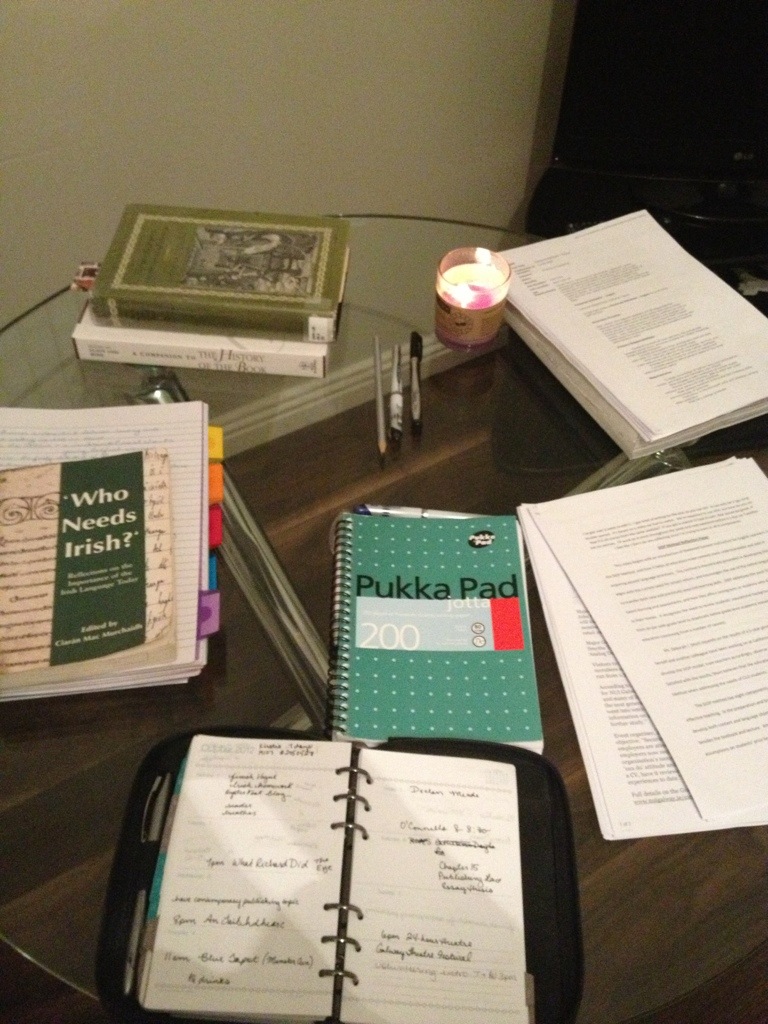
(Emails, newspaper articles, academic photocopies, foreign and “non-widely spoken” languages, workbooks, homework, laptops, iPhones, literary journals, post-its, expired ephemera, postal parcels, scripted address labels, television subtitles, blog.)

I was late for my first class because I was sitting in the Irish-language cafe shooting off emails to sources for my first article in the student newspaper.

I arrived at Irish for Beginners and my professor gave me some materials he’d photocopied for me after I requested he expand on the “Irish terms for writing technology” topic. Of the three documents, one was in Irish, one in English, and one in French.

I realized I had forgotten my practice book and, alas, my homework. I took notes in my notebook, which is almost full (three out of five subjects have no more room for notes). Last week’s homework was returned to us and I got full marks!

My laptop battery was dead so I read the reply emails on my iPhone. One source crapped out on me, but the other proved extremely useful.

Camped out in the library to use WiFi. Got a rare email from my father, which is always good for a giggle.

Fiddled around with PayPal, essentially opening a third account because I couldn’t add my Irish shipping address to an account opened in the States, so I could subscribe to The Stinging Fly. This is the first time I’ve ever subscribed to a literary journal, but since I’ll be here for a year and I just met the editor on Friday, I thought it would be a wise use of my money (only 20 euro!).

Downloaded free (and legal!) PDF version of Lawrence Lessig’s Free Culture: How Big Media Uses Technology and the Law to Lock Down Culture and Control Creativity to my desktop.

Searched catalogue for book I should read before next week. It’s locked away somewhere confusing, so I’ll try again tomorrow.

Rifled through all the schwag I picked up at the event I was covering to compare what I expected to see with what I actually did see. Revised the newspaper article.

Went to the postgrad room and printed the article for a final edit. Also printed materials for class.

Received email from Contemporary Publishing professor detailing materials needed for tomorrow’s class: post-its, markers, old copies of ROPES and any other literary magazines we like.

Borrowed a few literary magazines from the postgrad room (Granta, The Stinging Fly, and An Sionnach). Also “borrowed” some expired ephemera off a bulletin board, which is now decorating my apartment.

Went back to the library to find old copies of ROPES, which cannot be removed from the library. Kicked myself for not bringing the 2010 edition I have at home and for not buying the 2009 edition I saw in Charlie Byrne’s last week. Sat on the floor in the stacks and flipped through every single old copy the library had (all 20). Wrote down the prices, printers, and the names of famous contributors.

Got a lift from a friend to the faraway post office to pick up a package. Admired the fancy script my friend back home used to write my name and address.

Break for meal (salad with herring), exercise (walk around the horse-racing track!), and TV (old episodes of Malcolm in the Middle and Cold Case).

Came home and submitted the article for the newspaper.

Kept the TV tuned to TG4 (it’s not my fault they air Gossip Girl in English) and got my evening’s dose of Gaeilge while writing the world’s most pointless blog entry.
Galway Theatre Festival

20121008-000154.jpg

Tonight, I went to the culmination – at least for me – of the Galway Theatre Festival, which has been running this past week at venues all over town. I went to three plays over the course of the week, and for someone who claims to not like theatre, I had an overall pleasant experience.

I bought tickets for the Wednesday night opening of An Taibhdhearc, the Irish-language theatre in Middle Street, to see if I couldn’t challenge my Beginner’s Irish. The very first show in the theatre was to be Pinocchio, so I thought it might be an easy story to follow. This wasn’t Disney’s Pinocchio, but rather Pinocchio: A Nightmare, in which our little wooden boy is now a hardheaded Irish teenager (played by an actress with an accent I’m told is Corkian). The creativity employed in the bilingual production provided a great example for how I – or anyone, really – should approach learning Ireland’s native language. Bilingual conversations where one character’s Irish question could be deduced by the other’s English answers, humorous descriptive placards before scenes, detailed sound effects produced on stage by an actor visible to the audience, and simply great acting made it easy to see the complementary interaction between Gaeilge and English in modern Ireland.

The next morning, I caught the 11am showing of Sanctuary at the Blue Teapot Theatre. This was a play about the love lives of people with intellectual disabilities, and it was very sweet and funny. One of the supporting actresses, who becomes involved in a secondary love story, had some of the best comedic timing and deadpan delivery I’ve ever seen. It didn’t hurt that the group’s cool-but-sensitive-and-understanding carer, Tom, was played by a very attractive actor that had several girls in the audience giggling. An inspired set design and a few loose parallels to another Disney movie, Beauty and the Beast, brought it all together around the question we all sometimes ask ourselves: How could anybody love me?

I finally got to see the inside of the Druid Theatre when I turned up (and I seriously considered not going) for the 5-euro event “24 Hour Theatre” tonight. The participants (many of whom I recognized from campus) had 24 hours to write, rehearse, and perform 15-20 minute plays. There were three groups, with three plays, which grew increasingly more meta over the course of the evening. We started with a small-town Ireland take on Hansel and Gretel, moved to a hilarious group therapy session, and were spoken to directly about the nature of drama by the characters that manifested on stage as the actors themselves. The first play had the best writing, the second had the best acting, and the third had the best personalities. All in all, it was very inspiring and I’m glad I went.

Throughout the week, I’ve been hearing about all the plays I should have seen. Home has been praised frequently, and there was some Beckett I didn’t know about when I bought my tickets. I also heard good things about The Butcher Molloy, which is apparently set during the last time Galway won the hurling final and thus could have been a lot more poignant if the Tribesmen had gotten the win last Sunday.

20121008-000123.jpg

Great Irish Book Week 2009

20121005-174646.jpg

Let’s pretend it’s 2009; we’ve travelled in time to the same day in October, just three years earlier.

I want to tell you all about Great Irish Book Week, an event organized by Publishing Ireland to celebrate local publishers, bookseller, authors, wholesalers, and media. It’s happening October 24-31, with events all over Ireland (and perhaps some mad Halloween wrap party?).

There’s even a free publication called Be Inspired, which is a literary sample platter of everything Irish publishers have on offer. It’s quite a treat!

So back here today in 2012, I found this book in Charlie Byrne’s (and paid 4 euro for it) because the editor of Stinging Fly Magazine and Stinging Fly Press, Declan Meade, was coming in for Publishers on Publishing, and there was an excerpt of Life in the Universe in this book.

Just flipping through this book, though, has been such a confirmation of everything I’m learning in this course. I now recognize the names of most of the publishers, and can name the person in charge at about half of them. I know who is responsible for the last big bestseller, and I’m starting to pick up on themes in the writing itself. I also recognize a few words in Irish!

I don’t know if Great Irish Book Week was just a one-off event or if they plan to hold another one every few years… but I love this book. Absolutely love it. Enrolling in this MA programme may be the smartest thing I have ever done, and this little freebie confirms it.

20121005-174746.jpg

Bring free books to postgraduate students (current, beautiful, literary books at that), and your publishing company will have fans for life. Fair play, Declan Meade.

Latin-Loan Words

20121004-231416.jpg

One of the first things I was warned of when I decided to take an Irish language course is that Irish is not a Latin-based language, and therefore, sounds nothing like anything I have ever heard before.

However, as with most languages, new technology brings new vocabulary. Words like “taxi” are easily recognizable across languages, and the internet has brought along a whole new global terminology that often breaches language barriers.

Last week in Irish for Beginners, my instructor said something that caught my attention. He said “the technology of writing came from the Latin,” meaning that even though Irish isn’t a Latin-based language, the invention of the printing press introduced a new technology that required a whole new set of terms.

For a variety of reasons I’ve yet to ennummerate, the Irish words for “book” and other words belonging to print culture are all Latin-based. In an attempt to tease out this connection for a possible essay topic in my Book History course, I emailed my Irish professor and asked him to clarify.

Turns out I was on the right track. He sent me confirmation of my interpretation of his statement, provided the title of a book and the location of an academic article on the topic, mentioned two additional professors on campus who might be able to help me, and printed out some more material for me to pick up.

It’s intimidating, because I don’t know Irish. I barely know how to say “hello” and “thank you.” I’m not sure if I’ll be able to handle this topic, or even where I want to go with it. I’m attempting to read The Printing Press as an Agent of Change right now, and there is a discussion of oral culture vs manuscript culture vs print culture that might be relevant, but I just don’t know yet.

Irish is a very precise and descriptive language. The term for another new piece of technology, the mobile phone, is “Fón póca,” which translates as “pocket phone.” I thought I might look at the Irish terms within print culture to see how they interpreted this new technology. If the creation of the codex was the last major revolution in the history of books, then how did they describe these new objects in Gaeilge?

But what else? Is it possible the Irish language influenced print culture in any way? I’ll need to read more before I know if there’s enough Book History here to warrant a paper. It’s a little scary.

I’ve been watching a lot of TG4 lately, which is the Irish language channel on my TV. The show that just finished was called Déanta in Éirinn, in which this dude drives around the country in a DeLorean and attempts to use only products made in Ireland. It was kind of sad – he found out that even the sticks they use in hurling are manufactured elsewhere.

I happened to see the episode where he goes into Eason’s looking for a book or magazine printed in Ireland. I thought this was already problematic, because even though Eason’s is an Irish bookseller, the company began life as an Irish stake in a British bookstore chain.

Of course, none of the mainstream magazines or superstar authors he asked about were available on pure Irish wood pulp, so he had to settle for a Pat McCabe title from an independent publisher, Raven Arts Press – which is the type of title this book snob thinks he should have been looking for in the first place.

But because this was the Irish language channel, all the interviewees had their titles spelled out on screen in Irish, so I learned two new book-related words in Gaeilge:

foilsitheoir = publisher

and

scríbhneoir = writer

“The loneliness is palpable.”


My boyfriend turned 33 on Monday. His fellow firefighters got him a birthday cake.

Last night, I went to a preview screening of the fantastic film What Richard Did at The Eye. The movie doesn’t come out until Friday, but I won a pair of tickets that also included a Q&A session with the director, Lenny Abrahamson.

I ended up going by myself.

A preview of possibly the best Irish film of the year – with the director in attendance – and I didn’t have anyone to take with me. I even posted it on Facebook, without any luck. It was definitely one of the low moments of my time in Ireland.

I don’t mind going to movies alone; I do it all the time at home, and I’ve done it three times already since I’ve been here (five if you count the films at the Grace Kelly Film Festival). Still, I was excited to win tickets and it would have been nice to take someone with me.

I do have friends here. I’m dragging one friend to the theatre next week for Steel Magnolias; another sat down with me for lunch at Ard Bia. My classmates are all nice, and I’m meeting more people from Texas than you would ever imagine could be in the west of Ireland at one time.

But I left my whole life behind. I’m not going to get too personal, but my boyfriend and my dog both celebrated birthdays this week back in Texas… and I can’t find someone to go to the movies with me. I’ve come to love my apartment, but it is literally half-empty.

I went to the aquarium the other day, and next to the seahorse tank, there was a sign saying that seahorses mate for life, so you’ll often see them swimming in pairs. In the water though, I could only find one seahorse. I searched the whole tank, peeking through the coral and checking all possible places another seahorse might hide, but there was only the one.

I don’t know if it was male or female, but the seahorse floated near the wall of the tank, up close and personal with its own reflection. Together, they made a lovely pair.


“Maybe I’m lonely; that’s all I’m qualified to be”

I am that seahorse; me and my imaginary friend, bumming around our two-bedroom fish tank. In a way, this is what I want – a quiet place and time to read – but that’s not healthy all the time.

So you get up and you just keep swimming. I spent all day on campus, and was actually pretty social. I hung with my classmates, talked about assignments, and walked back into town with a girl from the student newspaper.

The Galway Theatre Festival is going on right now, so tonight I went to Taibhdhearc na Gaillimhe – alone – to see an Irish language production of Pinocchio: A Nightmare (also incredible). The usher asked us to fill in the seats in front first, and there were a few Forrest Gump “seat’s taken” moments as I tried to follow his instructions.  I didn’t burst into tears, but simply moved on to the next row.

One young man turned back around and said “Actually, that one’s open,” pointing to a seat on the other side of him, smack in the middle of the row. I got settled in, and couldn’t help overhearing him speak to his friends in a North American accent.

I was hardly surprised when he mentioned he was from Texas.

And the winner is…

I had this crazy idea that I would read the whole Booker Prize short list before the award is announced. I now seriously doubt that will happen. The amount of reading I feel I need to do for my classes keeps growing.

A slightly more manageable goal presented itself last week, when a writer with strong Galway connections, Julian Gough, was shortlisted for the BBC International Short Story Award. His story, The iHole, is about the latest technology must-have: a portable black hole.

I wanted to read The iHole and the nine other stories on the shortlist before the announcement of the winner. The ceremony was scheduled for today, October 2, and has already happened in real time but I’m avoiding those corners of the internet (like Twitter, where I follow Julian Gough and first learned about the contest).

When I tried to track down the stories, I was taken to the BBC website, where recordings of each of the stories were available for download. So starting with The iHole at 2pm and listening in approximately 30-minute increments throughout the rest of the day – on my iPhone, natch – I’m just about to start the final story. Then I’ll go track down the winner and see if I agree.

I’m not sure if I like this downloads-of-readings-of-short-stories format, but it’s what had to be done today. I admit, I didn’t pay close enough attention to some of the entries, because short stories aren’t quite as good for walking the commute as the 90s nostalgia playlist I’ve been rocking since I got here.

Briefly: I liked The iHole, but it might rely too much on satire to win an international prize. There were a lot of Aussie stories, and I liked them all, but Before He Left the Family was probably the one I liked most. I was most intrigued by the Russian doll structure of In the Basement. And I have to be honest, I haven’t been paying adequate attention to this final entry, Sanctuary.

So here it is, I’m about to Google the winner… East of the West by Miroslav Penkov. It’s set in Bulgaria, and I believe this one was abridged.

When in Galway…

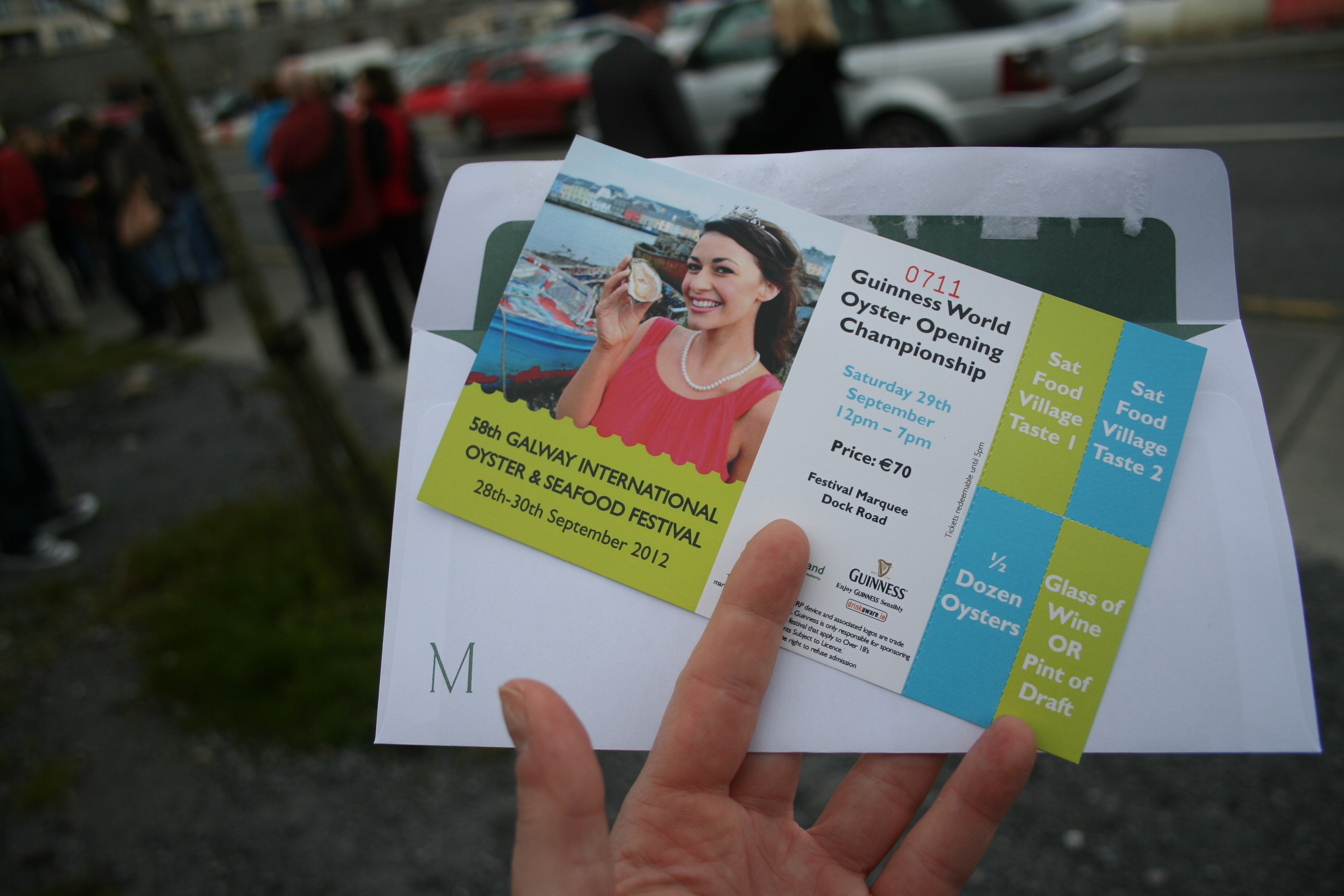
You go to the Oyster Festival. At least once.

With the sample dishes from Artisan…

(marinated monkfish and cherry tomato brochettes with fragrant basmati rice and curry aoli)

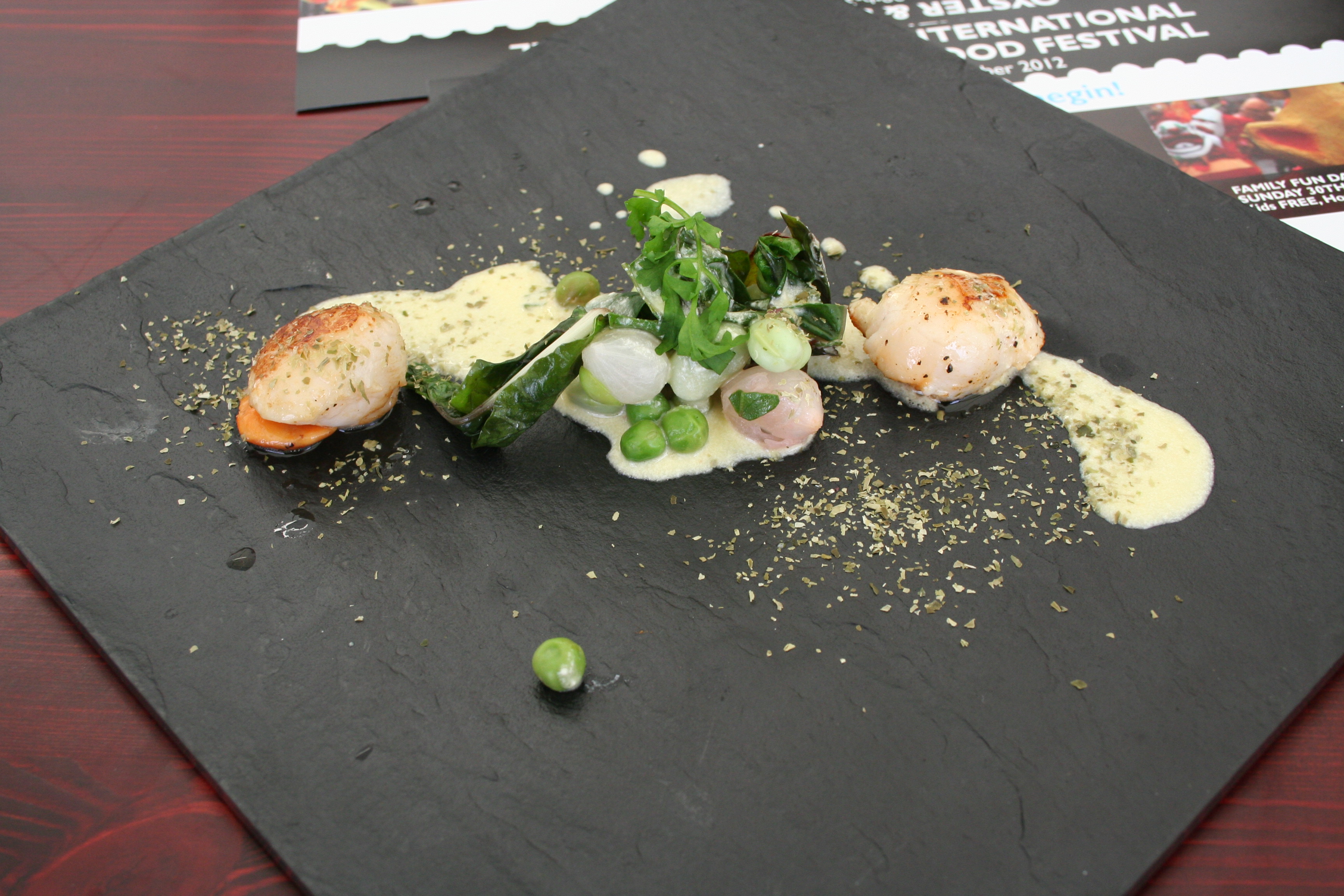
and West…

(seared local scallops ‘in shell’ with sea lettuce Beurre Blanc and sauteed vegetables)

the cooking demonstrations tent…

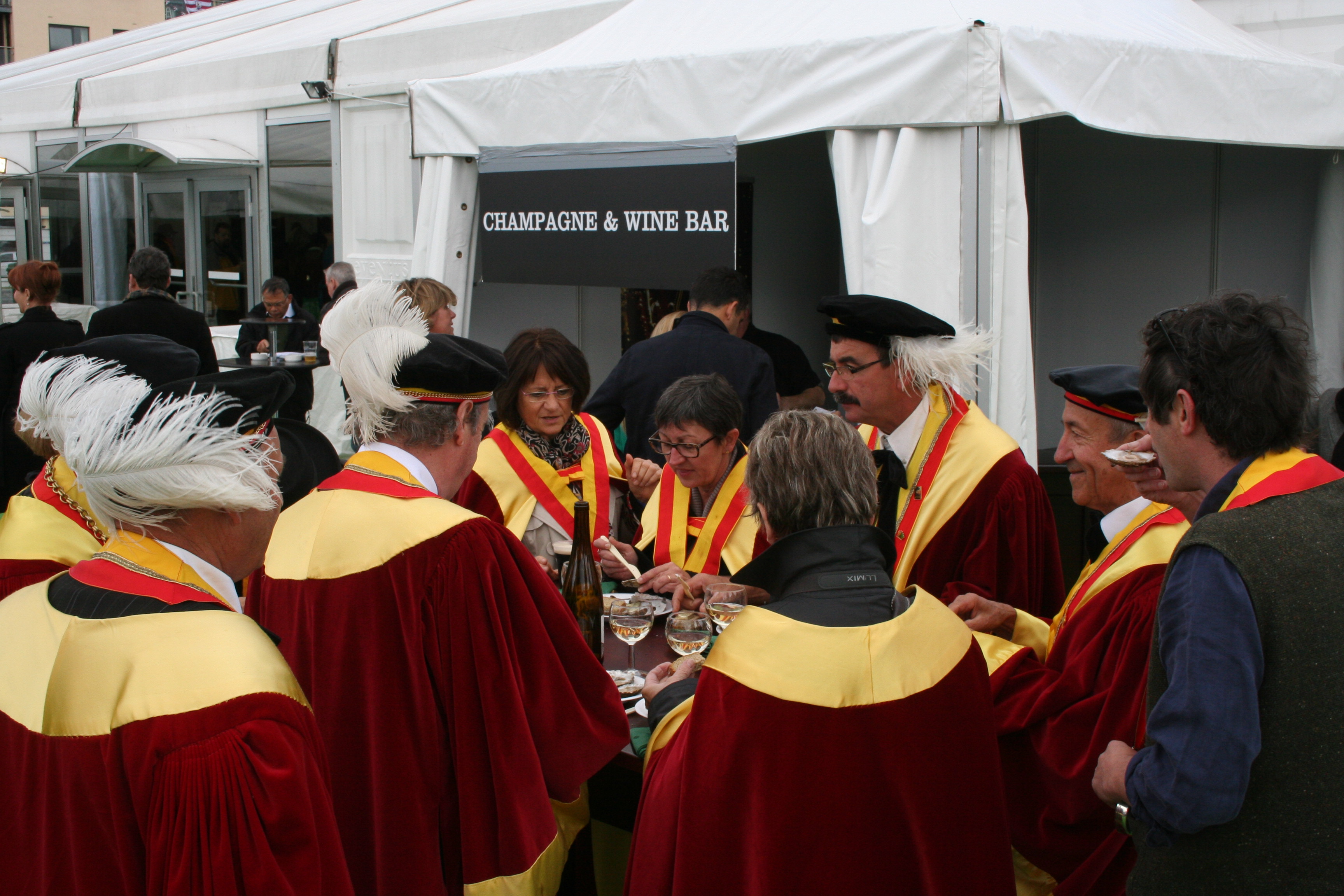
the people in funny outfits…

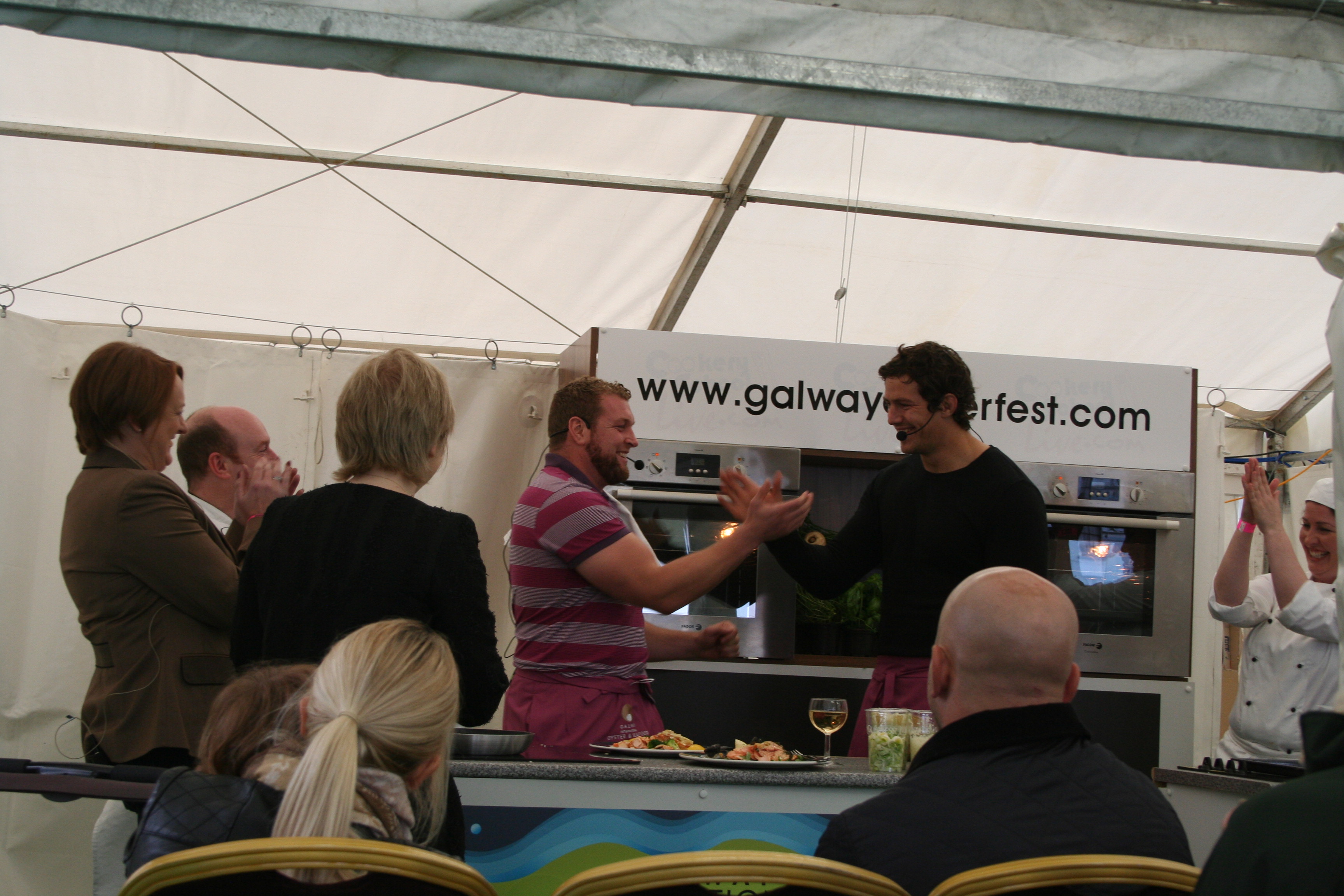
the professional rugby players in the kitchen…

Brett Wilkinson bested Mike McCarthy in an all-Connacht Rugby cooking competition.

the world championship oyster-opening (not shucking; not here) competition…

The professional oyster-openers from the USA (I don’t know which state) and the Czech Republic (the only female in the competition). The eventual champion ended up being locally sourced – Michael Moran, the third-time champion from County Galway. I love their aprons.

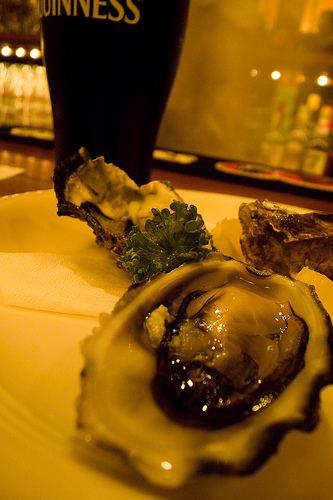
the complimentary half-dozen oysters and free pint (not pictured because I went home to take a break, leaving my camera behind so I could enjoy myself; and besides, they were served in plastic and not worth the photo opt, but oh so delicious)…

So here’s a Creative Commons image from [cipher] on PhotoRee.

and the excuse to wear fake pearls in broad daylight…

I’d say it was worth the price of admission. If only to experience it once.