Great Irish Book Week 2009

20121005-174646.jpg

Let’s pretend it’s 2009; we’ve travelled in time to the same day in October, just three years earlier.

I want to tell you all about Great Irish Book Week, an event organized by Publishing Ireland to celebrate local publishers, bookseller, authors, wholesalers, and media. It’s happening October 24-31, with events all over Ireland (and perhaps some mad Halloween wrap party?).

There’s even a free publication called Be Inspired, which is a literary sample platter of everything Irish publishers have on offer. It’s quite a treat!

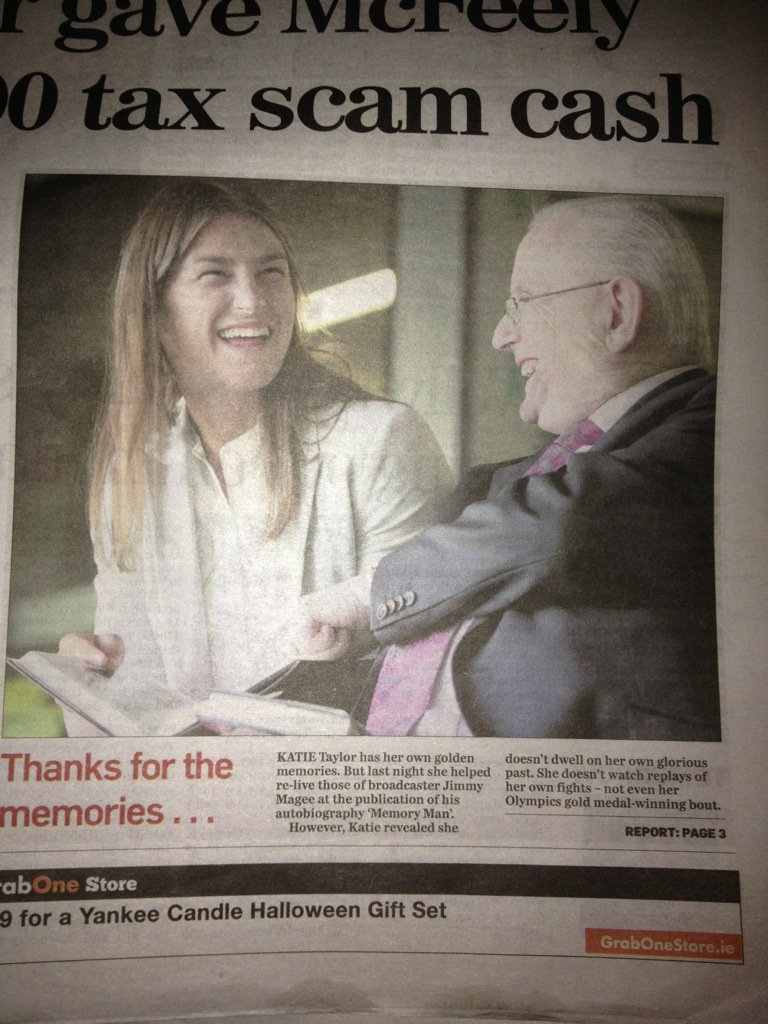
So back here today in 2012, I found this book in Charlie Byrne’s (and paid 4 euro for it) because the editor of Stinging Fly Magazine and Stinging Fly Press, Declan Meade, was coming in for Publishers on Publishing, and there was an excerpt of Life in the Universe in this book.

Just flipping through this book, though, has been such a confirmation of everything I’m learning in this course. I now recognize the names of most of the publishers, and can name the person in charge at about half of them. I know who is responsible for the last big bestseller, and I’m starting to pick up on themes in the writing itself. I also recognize a few words in Irish!

I don’t know if Great Irish Book Week was just a one-off event or if they plan to hold another one every few years… but I love this book. Absolutely love it. Enrolling in this MA programme may be the smartest thing I have ever done, and this little freebie confirms it.

20121005-174746.jpg

Bring free books to postgraduate students (current, beautiful, literary books at that), and your publishing company will have fans for life. Fair play, Declan Meade.
Libraries, Academic Presses, and Ebooks

When I read How to Get a Job in Publishing last week, the chapter on academic publishing included a memorable line:

“…librarians assume that they are financially supporting the academic reward system…”

It seemed to address the issue that university libraries spend a large portion of their budget buying the books written by faculty. It’s more complicated than that, so I might need to revisit that chapter.

I was reminded of this today when Lisa Hyde from Irish Academic Press (and the imprint Merrion Books) came in to speak to us for Publishers on Publishing. She was very interested in our academic book buying habits, and whether we get books in our field on the Kindle.

The last academic book I tried to buy on my Kindle was Let the People In: The Life and Times of Ann Richards. I was disappointed when I couldn’t find a Kindle version, and because it was more or less an impulse buy, I didn’t end up making a purchase.

When I’m trying to broaden my horizons by reading something I normally wouldn’t, I don’t necessarily want the expensive hardback that most academic presses produce. I would rather have a trade paperback or, better yet, an ebook. Neither one was available, so I moved on.

Ms. Hyde explained that high rates of returned stock from booksellers are the biggest fear in academic publishing. It seems cruel that the major source of frustration could be easily cured by the advent of ebooks.

Ms. Hyde said academic publishers have to look out for their authors, and it’s likely that everyone is holding their breath until the Apple/DOJ case is decided. A big portion of this is also that academic publishers “have the library market to consider,” and not all libraries have adopted ebook lending.

On a final note: Ms. Hyde spoke a lot about her work with Merrion Books, the new imprint of Irish Academic Press that leans more toward a trade market. One particular title she spoke of was Glenveagh Mystery, coming from Merrion Books in time for the Christmas season.

Ms. Hyde said she has worked in almost all areas of publishing except for fiction, partly because she doesn’t want to ruin fiction for herself. However, every time she brought up the difference between regular academic titles and what she is trying to do with Merrion Books, she used phrases like “she’s told a fabulous story.” I found it interesting that a narrative structure seems to be the unifying feature of all these works that transcend the “academic” label and appeal to a wider audience.

Monopolies and Wholesalers

So remember last Friday, when I was too tired to post about the DOJ case against Apple or the problem with Eason’s acquiring Argosy? Well, I lied.

The truth is, it didn’t matter how tired I felt that day. I could have been in perfect health and hopped up on espresso, and it wouldn’t have made a difference. I can’t properly blog about those things on my best day because I can’t wrap my mind around the impact on the publishing industry.

My publishing gurus have addressed these issues more succinctly than I ever could: Nathan Bransford in the States and Irish Publishing News here in Ireland. Eoin Purcell was our speaker in the Publishers on Publishing series this past Friday, and he was adamant that Eason’s buying Argosy is a very bad thing for small Irish publishers.

I understand Amazon’s price-penetrating strategy with the Kindle. I understand that monopolies are bad for business. I understand how vertical integration is giving control of the universe to five major corporations. I understand that consumers think they want low prices but are actually setting themselves up to be taken advantage of in the future. I understand all these things… in theory.

Real life is another matter. Blogging my opinions on movies or interesting things I read is one thing, but commenting on the state of the industry in which I hope to find employment is something else entirely. It’s all a bit too real. I become considerably less chatty.

A few months ago, Houghton Mifflin Harcourt declared bankruptcy as part of a financial restructuring package that, in the end, was very good for the company’s overall health. I was working contract for them at the time, and do you think I blogged about that? Hell no. I was too busy living it.

It’s one thing to read about these stories happening to someone else in some other industry (I still think the stock market is a fiction created by bored old boys on the golf course). It’s quite another to be staring into the wreckage and hoping that somewhere, amid all the flotsam and jetsam, is a job just for me.

I will try to be braver about these major issues in the future. For now, here’s a picture of my dog in some bluebonnets (I’m a little homesick, too).

Ethical Editing

Two stories that broke today got me thinking about literature and publishing.

First, Jonah Lehrer resigned from The New Yorker after Tablet Magazine called out the fabricated Bob Dylan quotes used in his book Imagine, published by Houghton Mifflin Harcourt in March 2012.

Then #countriesbyvoguewriters began trending on Twitter in response to the Newsweek article by Joan Juliet Buck that told her side of the story surrounding the glowing March 2011 Vogue profile of Asma al-Assad, the first lady of Syria.

All of which led me to ask:

Image