The Film Society screened this 2011 film tonight. It’s about a young woman’s struggle to leave her cult. The title refers to the way her identity becomes subsumed by the cult.
Mercy
I just spent 14 hours on campus, so I’m a bit punchy, and also very upset right now. I might regret posting this.
All day, I’ve been watching Facebook as one of my closest friends from college (who I never see anymore but still love like a brother) posted updates on the birth of his first child. In a photo taken at the hospital before labor started, his wife, who didn’t go to school with us, is wearing a hoodie with the name of our college emblazoned across the front.
I spent my evening in the campus chapel, covering a history lecture for the student newspaper and having polite little discussions with the campus Christians. I sometimes forget how pleasant church people can be. One of the chaplains told me: “I don’t know who you are, but you have a real warm, welcoming face. It’s a real asset to you.”
When I got home, my Facebook feed showed my college friend now has a healthy baby boy. I can’t describe what I was feeling, but it was deep and spiritual. My friend and I certainly weren’t among the good religious crowd on campus, but we talked a lot about God and helped each other through some tough times. It was a different type of faith.
The very next post on my Facebook feed was Texas Monthly‘s story about a psychotic prayer group leader who [ed: allegedly] had his 27-year-old wife murdered so she wouldn’t tell her therapist about the drugging and gang rapes he had [ed: allegedly] subjected her to over the course of their brief marriage.
They met at college. My college. Our college.
* I edited this the morning after I wrote it. In light of the Michael Morton case, also recently covered in Texas Monthly, I should be more careful about what I accept as truth. It was Bethany Leidlein Deaton’s “suicide” note that sent me over the edge, but the Michael Morton case also had some horrifying elements, all of which were proven false 25 years after his conviction. I’m leaving this post because I published it and I will stand by that, but I also need to do my part to make sure our justice system functions properly.
eBook Incunabula
At the Dublin Book Festival this weekend, the debate over ebooks vs books raised some questions about how closely the ebook needs to remain tied to the printed book. A major point of discussion in my Book History class has been incunabula – that is, books printed within the first 50 years after the invention of the printing press (circa 1450). I think we are kind of in the era of digital incunabula right now. And just like the incunabula of the 15th century mimicked the manuscripts of an earlier era, the ebooks of today are mimicking the printed book. This mimickry is not always necessary, and, as we saw in the case of incunabula, many of the old formatting traditions fall by the wayside.
I think it’s important to pause here and distinguish between text and format. All books contain text, whether is is hand-copied by scribes, printed by Gutenberg, impressed in Braille, recorded on an audiobook, or uploaded to an ereading device. What is changing is the way those lines of text are treated and presented: sheets of vellum gave way to bound paper which gave way to ereaders. The earliest text was engraved in stone, then inscribed on papyrus scrolls, then written on wooden tablets. The classic codex – that is, the bound book with pages that we turn as we read – very much belongs to the physical world. I think what is so exciting about this ebook revolution is that ebooks can become anything, and may not always resemble the books that sit on our shelves.
The first and most obvious example of ebooks holding on to traditions of the printed book is the concept of pages. My Kindle (a very early model) features buttons that say PREV[IOUS] PAGE and NEXT PAGE, but why? There are no page numbers on a Kindle book, so that word “page” doesn’t really make sense in this context. Yes, it is how I have always experienced a book, and no doubt this early Kindle (or ebook incunabulum) needs to be rooted in the familiar so readers can easily adopt the ebook format, but if a Kindle book is demarcated by percentages and locations, the concept of the page is a bit out of place. Even the earliest codices didn’t have page numbers, perhaps because people were still adjusting to the very concept of pages. Turning a page is something we do in the physical world with a print book – ereaders of the future may drop this feature once we move out of this ebook incunabula era and into a more fluid ereading experience.
Another concept that is definitely going to change is the book cover. I have never even looked at the cover of most of my ebooks, and I have trouble recognizing a book in the shop if I have only read it on my Kindle. I don’t browse for Kindle books in the Kindle store – I just buy titles I already know I want to read – so the concept of judging an ebook by it’s cover is completely lost on me. Half of the public domain books in the ibookstore are simply book icons with the title written in some boring font – no photo, no design. One of the speakers at the Dublin Book Festival, the CEO of StoryToys, actually said his app icon was his book cover. There is a overlap here between apps and ebooks/ibooks, but the fact that we have to make a distinction means that the tiny little square on your smart phone functions more like a book cover than the generic Moby Dick that is sitting on my iBookshelf.
Finally, my own personal Kindle pet peeve, which is definitely going to have to change (if it hasn’t already been updated on the fancier Kindles or other ereaders): bookmarks. This is my least favorite feature on the Kindle and, unfortunately, the one I have to use most often. Adding a bookmark requires two clicks and the presence of an obstructive screen on top of the text. Recovering a location I have bookmarked requires another two clicks and an entirely new screen, and clearing those bookmarks when I’m done requires three clicks and a reset of the bookmark menu to see the next bookmark. It definitely detracts from the reading experience. This is all a matter of how the reader uses bookmarks, and clearly I am not compatible with my Kindle 2.5.2. I much prefer my printed book technique, in which I use a post-it to mark the exact line of text I need, or, at the very least, rip up the book receipt and shove little shreds of paper way up close to the spine and hope the physical appearance of the text will jog my memory. Either way, the real-world bookmarks are easy to see, easy to navigate, and easy to remove when I am done with the book. If the newer Kindles and other ereaders have a one-click add/remove bookmark function or some sort of touch-and-highlight feature, then hurrah – ebooks are evolving.
I am not even going to touch on hyperlinking text or ebook interactivity because 1) that is certainly not my area of expertise and 2) it gets into the question of “Is it really a book if it makes sound / plays video / offers a gaming experience?” Those are debates better left for another day. I also don’t want to hypothesize too much by way of digital innovation or improvement, because if I knew the way ebooks were going to develop, I would make some investments right now and be a very rich woman in a few years. The whole point is that people more talented and innovative than me are going to make some very cool advances in ebook technology in the next few years, and they are going to astonish us all. It is a very exciting time to be learning about the publishing business.
We are still in the early years of the Information Age, and sometimes I think we forget how lucky we are to be living through this. The parallel between the print revolution and the digital revolution is just a tiny part of this significant time in history, but it’s enough to keep my imagination occupied for years to come.
Survey Says…
Please visit Survey Monkey to help me with my Contemporary Publishing business plan assignment. Muchas gracias.
Oh, FFS

Yes, I’m here for an MA in Literature and Publishing… but I’m pretty sure I’m getting a PhD in patience as well.
Giving Trees
One trend we’ve been discussing in Contemporary Publishing is the rise of the boutique publisher, who crafts books as beautiful objects in an age when everything is going digital. I was just reading an article on this subject, about books with hand-stitched binding, and while I agree that we shouldn’t be cutting down trees to print more paperbacks, I was confused as to why they would brag about making their books with recyclable paper. Recycled paper, I get. That would make sense, and would be noble enough to deserve some bragging. But if the book is a lovingly crafted object, then why would anyone care if the pages were recyclable?
It is one of life’s little cruelties that I feel this quiet affinity with trees… which are cut down to make books. I’ve been told in the past that recycled paper makes for terrible printing, but maybe someday we’ll come up with an alternative. Or we’ll buy ebooks of “disposable” titles, quit printing so much dross, and only kill trees for really special books. I dunno yet.
I was going through my photos from the Deireadh Seachtaine Gaeltachta (Gaeltacht Weekend) and I realized that all my favorites contain trees. So here you go, some scenes from the Ballynahinch Estate in Connemara:


I have been slacking on the writing – I will try to be better, but I can’t make any promises. Final exams and essays are looming. But I’ll try.
Look what arrived today…

Go n-éirí an bóthar leat.
Tomorrow, I leave for my immersion weekend in the Gaeltacht. I am terrified. I really hope I come back speaking perfect Irish.
(The title of this post means Bon voyage.)
Apologies
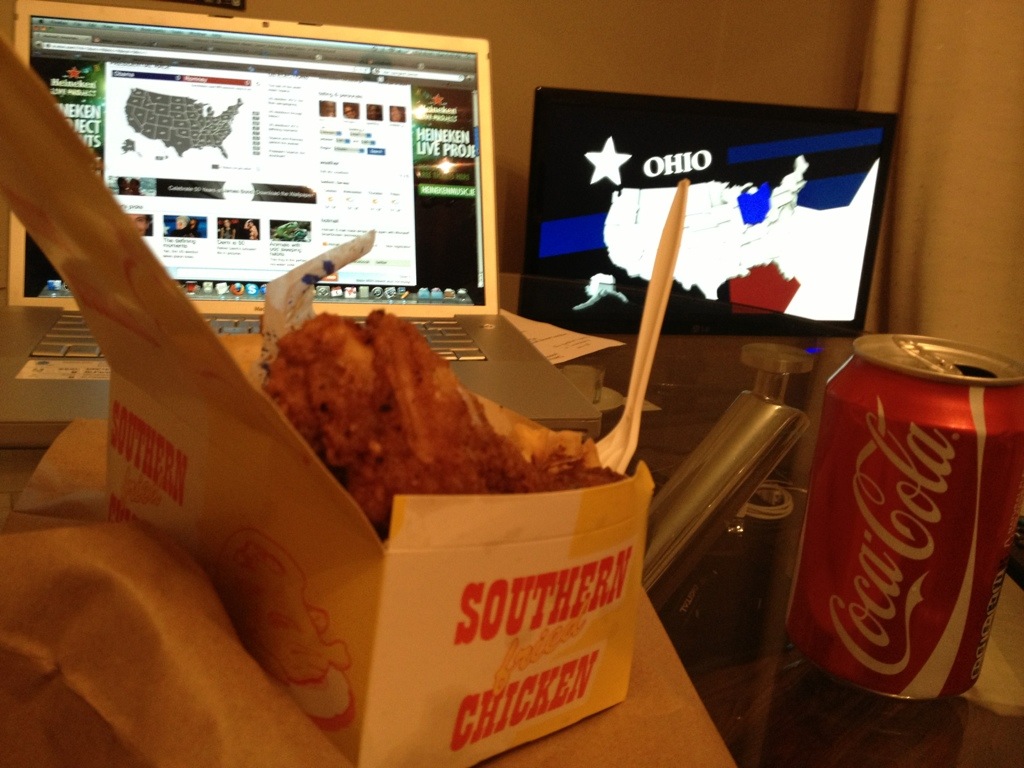
If I attempted to have a conversation with you today (and for some reason, I was very talkative), I need to apologize for making little to no sense. I stayed up ’til 5am watching election coverage, and caffeine only caused me to lose my breath when I spoke.
And to Kevin Barry, who kindly read short stories and spoke to the English Department about Doing Writing: I’m sorry I started crying during your reading of Across the Rooftops.
O Say Can You See?
A few things I wish I had pictures of so I could post them here:
- The Book of Kells, which I saw for the second time yesterday
- The first three books printed in the Irish language (I have to make a special scholarly request so I can go back to Trinity’s library and see them myself)
- The bookcase at Marsh’s Library in Dublin that was hit by machine gun fire in 1916. One bullet traveled through a book, ricocheted off the back of the bookcase, and passed through the book again. It was an incredible thing to see.
- The two elderly gentlemen I saw on my walk home, sitting side by side in a book-lined study and working on their laptaps. I imagine it was some scholarly collaboration taking place in the house near campus, overlooking the canal.
- My absentee ballot (it never showed; must have requested it too late)
Today in Irish for Beginners, we learned Amhrán na bhFiann, the Irish national anthem. It was taken up by the rebels in the GPO during the 1916 Easter Rising, and is always sung in Irish. The chorus includes lines like Tonight we man the gap of danger and ‘Mid cannons’ roar and rifles’ peal…
Sounds familiar, right? And the rockets’ red glare, the bombs bursting in air… Funny how both our national anthems are about fighting the British.
Happy election night, y’all!
 The Galway Train